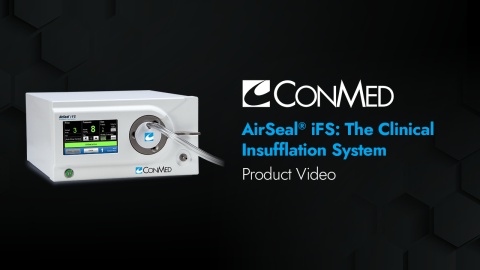
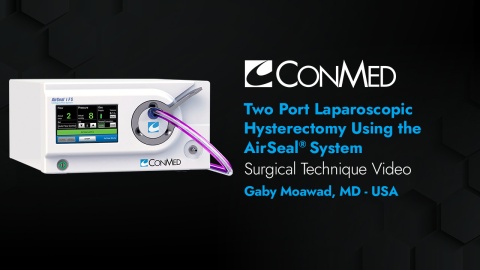
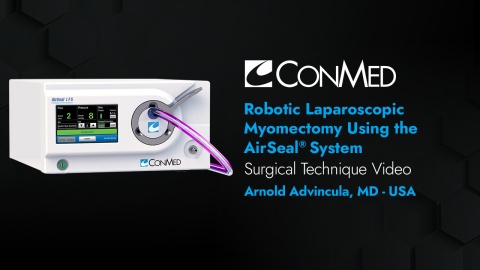
AirSeal® iFS
Insufflator
The clinical insufflation system revolutionizing recovery
Insufflator
The clinical insufflation system revolutionizing recovery
A boldly innovative CO2 insufflation solution that positively affects your patients’ intra and postoperative outcomes. Reduce the impact on patients' bodies by operating at low intra-abdominal pressure with AirSeal®—the only insufflation system backed by clinical data.1-38, ‡
A total of 11,520 patients were enrolled across 38 peer-reviewed publications that demonstrate positive patient outcomes of AirSeal® insufflation, spanning 7 surgical specialties.1-40
AirSeal® reduces rates of overall and clinically significant postoperative complications including:

Clinical studies demonstrated the benefits of a low-pressure approach with AirSeal® insufflation compared to standard insufflation, including reduction of:
A proprietary access port creates a responsive, physics-based gas barrier to enable the most stable pneumoperitoneum possible. This dedication to innovation ensures that we provide unparalleled pressure precision and stability in every procedure.
AirSeal® provides uninterrupted visibility and a clear operative field through stable pneumoperitoneum and constant smoke evacuation to maintain exposure even during leaks and aggressive suction, enabling you to operate efficiently at low pressure.
Close to 3,000 AirSeal® patients across 20 studies experienced a reduction in post-op pain in the PACU when AirSeal® was used at low pressure intraoperatively.
The enhanced recovery enabled by low pressure insufflation should be made available to every patient, regardless of background or circumstances. Peer-reviewed data demonstrates that AirSeal® at low pressure positively contributes to ERAS protocols.12
Operating at low pressure with AirSeal® is an intervention that could have cost-saving implications in healthcare. AirSeal® has been found to reduce a patient’s PACU time10 and length of stay9,12-16,20-24. AirSeal® has also been found to offer significant cost implications by lowering:




Ready to improve patient outcomes?
Explore AirSeal® for your practice
Documents and Specifications
Experience the Difference
* Based on internal sales data.
† Savings based on 2022 National Average of Kaiser Foundation Costs of Care in for-profit hospitals.
‡ Based on a 2025 market analysis
1 Saway JP, McCaul M, Mulekar MS, McMahon DP, Richards WO. Review of Outcomes of Low Verses Standard Pressure Pneumoperitoneum in Laparoscopic Surgery. Am Surg. 2022;88(8):1832-1837. doi:10.1177/00031348221084956
2 Abaza R, Ferroni MC. Randomized Trial of Ultralow vs Standard Pneumoperitoneum during Robotic Prostatectomy. J Urol. 2022;208(3):626-632. doi:10.1097/JU.0000000000002729
3 Covotta M, Claroni C, Torregiani G, et al. A Prospective, Randomized, Clinical Trial on the Effects of a Valveless Trocar on Respiratory Mechanics During Robotic Radical Cystectomy: A Pilot Study. Anesth Analg. 2017;124(6):1794-1801. doi:10.1213/ANE.0000000000002027.
4 Desroches B, Porter J, Bhayani S, Figenshau R, Liu PY, Stifelman M. Comparison of the Safety and Efficacy of Valveless and Standard Insufflation During Robotic Partial Nephrectomy: A Prospective, Randomized, Multi-institutional Trial. Urology. 2021;153:185-191. doi:10.1016/j.urology.2021.01.047
5 Bucur P, Hofmann M, Menhadji A, et al. Comparison of Pneumoperitoneum Stability Between a Valveless Trocar System and Conventional Insufflation: A Prospective Randomized Trial. Urology. 2016;94:274-280. doi:10.1016/j.urology.2016.04.022
6 Razdan S, Ucpinar B, Okhawere KE, Badani KK. The Role of AirSeal in Robotic Urologic Surgery: A Systematic Review. J Laparoendosc Adv Surg Tech. 2023;33(1). doi:10.1089/lap.2022.0153
7 Wei M, Yang W, Zhou J, et al. Comparison of AirSeal versus conventional insufflation system for retroperitoneal robot-assisted laparoscopic partial nephrectomy: a randomized controlled trial. World J Urol. 2024;42(1):90. Published 2024 Feb 21. doi:10.1007/s00345-024-04819-3
8 Faizan M, Shariq K, Abbas FS, Murtaza DA, Naveed A, Tarar HM, Fahim R, Kumar S, Siddiqui SA. A comparison of CO2-related complications in partial nephrectomies between the AirSeal system and conventional system: a systematic review and meta-analysis. J Robot Surg. 2025;19:104. doi:10.1007/s11701-025-02227-2
9 Sroussi J, Elies A, Rigouzzo A, et al. Low pressure gynecological laparoscopy (7mmHg) with AirSeal® System versus a standard insufflation (15mmHg): A pilot study in 60 patients. J Gynecol Obstet Hum Reprod. 2017;46(2):155-158. doi:10.1016/j.jogoh.2016.09.003
10 Buda A, Di Martino G, Borghese M, et al. Low-Pressure Laparoscopy Using the AirSeal System versus Standard Insufflation in Early-Stage Endometrial Cancer: A Multicenter, Retrospective Study (ARIEL Study). Healthcare (Basel). 2022;10(3):531. Published 2022 Mar 14. doi:10.3390/healthcare10030531
11 Hamid, M., Zaman, S., Mostafa, O.E.S. et al. Low vs. conventional intra-abdominal pressure in laparoscopic colorectal surgery: a prospective cohort study. Langenbecks Arch Surg 410, 12 (2024). https://doi.org/10.1007/s00423-024-03579-3
12 Foley CE, Ryan E, Huang JQ. Less is more: clinical impact of decreasing pneumoperitoneum pressures during robotic surgery. J Robot Surg. 2021;15(2):299-307. doi:10.1007/s11701-020-01104-4
13 Abaza R, Martinez O, Ferroni MC, Bsatee A, Gerhard RS. Same Day Discharge after Robotic Radical Prostatectomy. J Urol. 2019;202(5):959-963. doi:10.1097/JU.0000000000000353
14 Celarier S, Monziols S, Célérier B, et al. Low-pressure versus standard pressure laparoscopic colorectal surgery (PAROS trial): a phase III randomized controlled trial. Br J Surg. 2021;108(8):998-1005. doi:10.1093/bjs/znab069
15 Ferroni MC, Abaza R. Feasibility of robot-assisted prostatectomy performed at ultra-low pneumoperitoneum pressure of 6 mmHg and comparison of clinical outcomes vs standard pressure of 15 mmHg. BJU Int. 2019;124(2):308-313. doi:10.1111/bju.14682
16 Ramshaw B, Forman B, Heidel E, Dean J, Gamenthaler A, Fabian M. A Clinical Quality Improvement (CQI) Project to Improve Pain After Laparoscopic Ventral Hernia Repair. Surg Technol Int. 2016;29:125-130.
17 Ramshaw B, Vetrano V, Jagadish M, Forman B, Heidel E, Mancini M. Laparoscopic approach for the treatment of chronic groin pain after inguinal hernia repair : Laparoscopic approach for inguinodynia. Surg Endosc. 2017;31(12):5267-5274. doi:10.1007/s00464-017-5600-3
18 Feng TS, Heulitt G, Islam A, Porter JR. Comparison of valve-less and standard insufflation on pneumoperitoneum-related complications in robotic partial nephrectomy: a prospective randomized trial. J Robot Surg. 2021;15(3):381-388. doi:10.1007/s11701-020- 01117-z 2.
19 Grieco, M., Tirelli, F., Agnes, A., Santocchi, P., Biondi, A., & Persiani, R. (2021). High-pressure CO2 insufflation is a risk factor for postoperative ileus in patients undergoing TaTME. Updates in surgery, 73(6), 2181–2187. https://doi.org/10.1007/s13304-021-01043-1
20 Rohloff M, Cicic A, Christensen C, Maatman TK, Lindberg J, Maatman TJ. Reduction in postoperative ileus rates utilizing lower pressure pneumoperitoneum in robotic-assisted radical prostatectomy. J Robot Surg. 2019;13(5):671-674. doi:10.1007/s11701-018-00915-w
21 Kikhia, R. M., Price, K., Alli, V., Pryor, A., Gracia, G., Rubano, J., Schnur, J., & Telem, D. (2017). Prospective evaluation of low insufflation pressure cholecystectomy using an insufflation management system versus standard CO2 pneumoperitoneum. SAGES Annual Meeting Abstracts Archive.
22 Ayoub CH, Armache AK, El-Asmar JM, et al. The impact of AirSeal® on complications and pain management during robotic-assisted radical prostatectomy: a single-tertiary center study. World J Urol. 2023;41(10):2685-2692. doi:10.1007/s00345-023-04573-y
23 Zhi W, Wang Y, Wang L, Yang L. Comparative assessment of safety and efficacy between the AirSeal system and conventional insufflation system in robot-assisted laparoscopic radical prostatectomy: a systematic review and meta-analysis. J Robot Surg. 2024;18(1):291. Published 2024 Jul 23. doi:10.1007/s11701-024-02000-x
24 Vasdev N, Martin N, Hackney AB, Piedad J, Hampson A, Shan G-M, et al. Comparing different pneumoperitoneum (12 vs. 15 mmHg) pressures with cytokine analysis to evaluate clinical outcomes in patients undergoing robotic-assisted laparoscopic radical cystectomy and intracorporeal robotic urinary diversion. BJUI Compass. 2023; 4(5): 575–583. https://doi.org/10.1002/bco2.240
25 George, A. K., Wimhofer, R., Viola, K. V., Pernegger, M., Costamoling, W., Kavoussi, L. R., & Loidl, W. (2015). Utilization of a novel valveless trocar system during robotic-assisted laparoscopic prostatectomy. World journal of urology, 33(11), 1695–1699. https://doi.org/10.1007/s00345-015-1521-8
26 Fan, G., Chen, Y., Wang, J., Wu, Y., Wang, Y., Hu, K., & Tang, T. (2024). Perioperative outcomes and safety of valveless insufflation system in minimally invasive urological surgery: A systematic review and meta-analysis. Journal of Robotic Surgery, 18, Article 269. https://doi.org/10.1007/s11701-024-02023-4[1]
27 Yezdani, M., Yu, S.-J., Lee, A., Taylor, B., McGill, A., Monahan, K., & Lee, D. (2016). MP23-17 IMPROVED OUTCOMES DURING ROBOTIC PROSTATECTOMY UTILIZING AIRSEAL TECHNOLOGY. Journal of Urology, 195(4S), e268. https://doi.org/10.1016/j.juro.2016.02.739 (Original work published April 1, 2016)
28 Rydlewicz, J. A., Suzo, A. J., Mikami, D. J., & Needleman, B. J. (2025). Retrospective study of the AirSeal™ system for laparoscopic bariatric surgery. Journal of Minimally Invasive Surgery, 32(2), 123-130. The Ohio State University Wexner Medical Center. https://doi.org/10.1007/s00464-025-01234-5[1]
29 Annino, F., Topazio, L., Autieri, D., Verdacchi, T., De Angelis, M., & Asimakopoulos, A. D. (2017). Robotic partial nephrectomy performed with Airseal versus a standard CO2 pressure pneumoperitoneum insufflator: a prospective comparative study. Surgical endoscopy, 31(4), 1583–1590. https://doi.org/10.1007/s00464-016-5144-y
30 Boualaoui, I., Bey, E., De Villeneuve, M. H., Dergamoun, H., Droupy, S., & Wagner, L. Medico-Economic Impact of the AirSeal® Insufflator: Example of Laparoscopic Sacrocolpopexy. Clin Surg. 2021; 6, 3084.
31 de'Angelis, N., Abdalla, S., Carra, M. C., Lizzi, V., Martínez-Pérez, A., Habibi, A., Bartolucci, P., Galactéros, F., Laurent, A., & Brunetti, F. (2018). Low-impact laparoscopic cholecystectomy is associated with decreased postoperative morbidity in patients with sickle cell disease. Surgical endoscopy, 32(5), 2300–2311. https://doi.org/10.1007/s00464-017-5925-y
32 Forte, F., Tripodi, D., Pironi, D., Corongiu, E., Gagliardi, F., Frisenda, M., Gallo, G., Quarantiello, A., Di Lorenzo, G., Cavaleri, Y., Salciccia, S., Lori, E., & Sorrenti, S. (2023). Comparison of laparoscopic partial nephrectomy performed with AirSeal® system vs. standard insufflator: results from a referral center. Frontiers in surgery, 10, 1220332. https://doi.org/10.3389/fsurg.2023.1220332
33 Katoh, H., Ikeda, Y., Saito, Y. et al. The Usefulness of AirSeal™ Intelligent Flow System in Gas Insufflation Total Endoscopic Thyroidectomy. Indian J Otolaryngol Head Neck Surg 75, 115–120 (2023). https://doi.org/10.1007/s12070-022-03257-0
34 La Falce, S., Novara, G., Gandaglia, G., Umari, P., De Naeyer, G., D'Hondt, F., Beresian, J., Carette, R., Penicka, M., Mo, Y., Vandenbroucke, G., & Mottrie, A. (2017). Low Pressure Robot-assisted Radical Prostatectomy With the AirSeal System at OLV Hospital: Results From a Prospective Study. Clinical genitourinary cancer, 15(6), e1029–e1037. https://doi.org/10.1016/j.clgc.2017.05.027
35 Lu, Y., Zou, Q., Jiang, B., & Li, Q. (2024). Perioperative outcomes and safety of valveless insufflation system in minimally invasive urological surgery: a systematic review and meta-analysis. International journal of surgery (London, England), 110(9), 5763–5770. https://doi.org/10.1097/JS9.0000000000001634
36 Miyano, G., Morita, K., Kaneshiro, M., Miyake, H., Nouso, H., Yamoto, M., Koyama, M., Nakano, R., Tanaka, Y., Fukumoto, K., & Urushihara, N. (2015). Laparoscopic Toupet Fundoplication using an Air Seal Intelligent Flow System and Anchor Port in a 1.8-kg infant: A Technical Report. Asian journal of endoscopic surgery, 8(3), 357–360. https://doi.org/10.1111/ases.12182
37 Paull, J. O., Parsacandola, S. A., Graham, A., Hota, S., Pudalov, N., & Obias, V. (2021). The impact of the AirSeal® valve-less trocar system in robotic colorectal surgery: a single-surgeon retrospective review. Journal of robotic surgery, 15(1), 87–92. https://doi.org/10.1007/s11701-020-01071-w
38 Shahait, M., Cockrell, R., Yezdani, M., Yu, S. J., Lee, A., McWilliams, K., & Lee, D. I. (2019). Improved Outcomes Utilizing a Valveless-Trocar System during Robot-assisted Radical Prostatectomy (RARP). JSLS : Journal of the Society of Laparoendoscopic Surgeons, 23(1), e2018.00085. https://doi.org/10.4293/JSLS.2018.00085